ORI Pitch Jam 2026
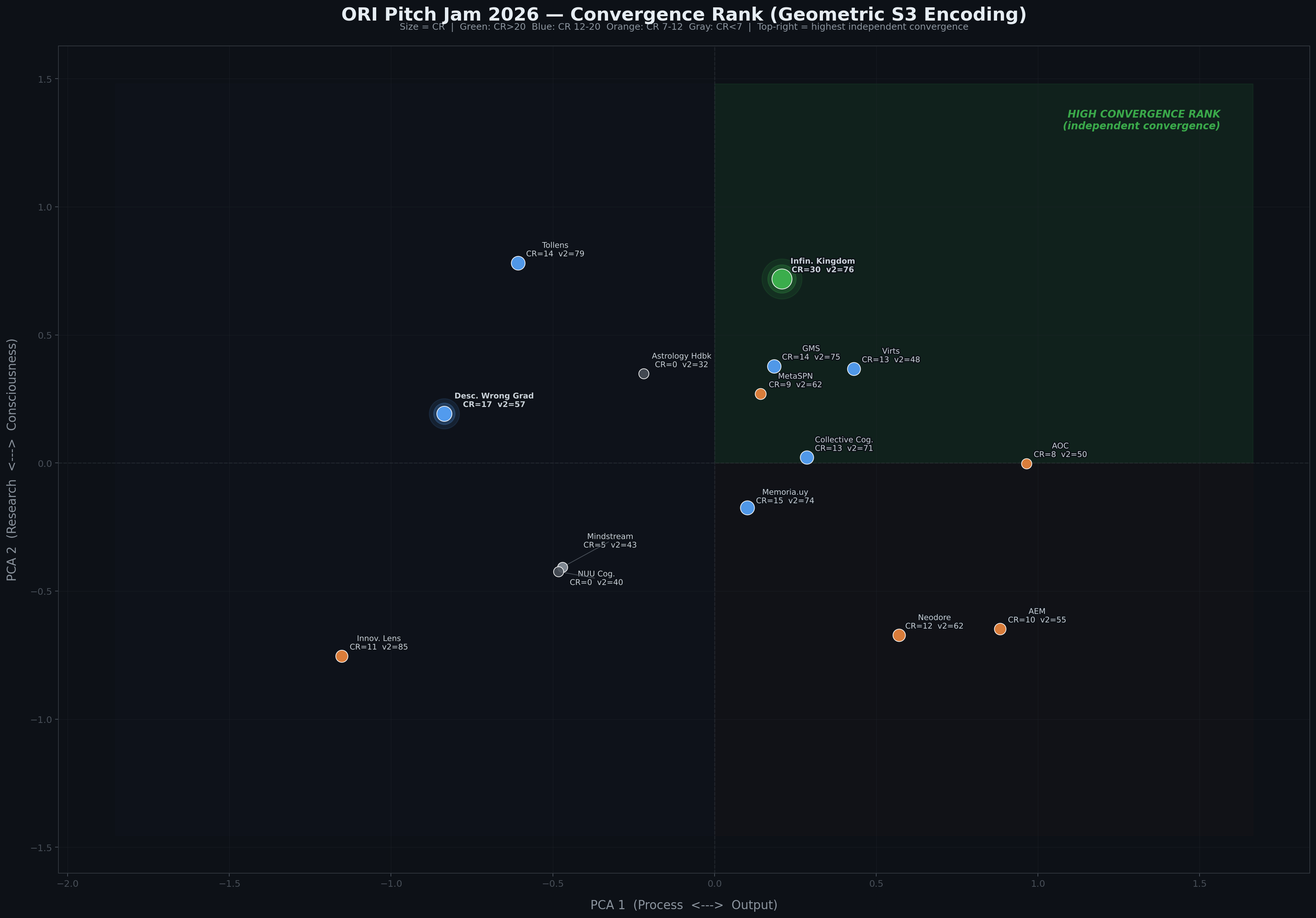
What Is Convergence Rank?
Conventional scoring (v2) measures artifact maturity: does something exist, is it validated, is the ask calibrated? Convergence Rank measures something different: how many structurally independent frameworks converge on the same insight?
Two projects that agree via the same framework provide redundancy. Two that agree via different frameworks provide triangulation. The value of agreement scales with the geodesic distance between frameworks on S³ — not the number of agreements.
CR(Project) = σ × ∑(dconverger × wtemporal)
Where σ = closure significance (distance from triviality), d = geodesic distance between project encodings, and w = temporal weight rewarding early arrival.
Encoding Dimensions
Each project scored on 4 axes, normalized to a unit quaternion on S³:
| d1: Mechanism | Process/system (−1) ↔ Output/content (+1) |
| d2: Domain | Research/epistemic (−1) ↔ Consciousness/experience (+1) |
| d3: Approach | Incremental/refinement (−1) ↔ Revolutionary/foundational (+1) |
| d4: Methodology | Physical/measurement (−1) ↔ Philosophical/theoretical (+1) |
Independence threshold θ = 0.6 rad. Convergers below θ contribute 0 to CR.
Final Rankings
| CR Rank | Project | CR | σ | ∑d | v2 Score | v2 Rank | Shift | Tier |
|---|---|---|---|---|---|---|---|---|
| 1 | Infinite Kingdom | 29.7 | 8 | 3.71 | 76 | 3 | +2 | CR > 20 |
| 2 | Descending Wrong Gradient | 16.9 | 7 | 2.41 | 57 | 9 | +7 | CR 12-20 |
| 3 | Memoria.uy | 14.6 | 6 | 2.44 | 74 | 5 | +2 | CR 12-20 |
| 4 | Tollens | 14.1 | 9 | 1.56 | 79 | 2 | −2 | CR 12-20 |
| 5 | GMS | 13.6 | 6 | 2.27 | 75 | 4 | −1 | CR 12-20 |
| 6 | Collective Cognition | 13.2 | 7 | 1.88 | 71 | 6 | 0 | CR 12-20 |
| 7 | Virts | 12.6 | 6 | 2.10 | 48 | 12 | +5 | CR 12-20 |
| 8 | Neodore | 11.5 | 9 | 1.27 | 62 | 7 | −1 | CR 7-12 |
| 9 | Innovation Lens | 10.9 | 7 | 1.56 | 85 | 1 | −8 | CR 7-12 |
| 10 | AEM | 10.0 | 8 | 1.25 | 55 | 10 | 0 | CR 7-12 |
| 11 | MetaSPN/Marvin | 8.9 | 5 | 1.78 | 62 | 8 | −3 | CR 7-12 |
| 12 | AOC | 7.8 | 5 | 1.56 | 50 | 11 | −1 | CR 7-12 |
| 13 | Mindstream | 4.9 | 4 | 1.22 | 43 | 13 | 0 | CR < 7 |
| 14 | NUU Cognition | 0.0 | 3 | 0.00 | 40 | 14 | 0 | CR 0 |
| 15 | Astrology Handbook | 0.0 | 6 | 0.00 | 32 | 15 | 0 | CR 0 |
Key Findings
#1: Infinite Kingdom is the structural winner
Three genuinely independent convergers at d > 1.2: Neodore (philosophical/morality, d=1.27), AEM (philosophical/phenomenology, d=1.25), Descending Wrong Gradient (biological/AI, d=1.19). Three structurally distant positions converging on "formalize the unformalizable." CR = 29.7, highest in the batch.
#2: Innovation Lens drops from #1 to #9
Best product in the batch (40M+ papers, arXiv white paper). But only one converger: Tollens at d=1.56. Without Tollens, CR = 0. The conventional #1 has the least structurally validated insight. Artifact quality ≠ convergence quality.
#3: Neodore + AEM are the same projection
Qualitative analysis rated them as independent (d=6). Geometry says d=0.230 — nearly identical. Both are philosophical, revolutionary, consciousness-domain. Different content, same framework. The "formalize" cluster has two independent members, not three.
#4: Descending Wrong Gradient jumps from #9 to #2
Converges with Mindstream (d=1.22) and Infinite Kingdom (d=1.19) — both genuinely independent. The bio-alternative cluster connecting to Infinite Kingdom was invisible in qualitative analysis.
#5: The civic stack is closer than it looks
Collective Cognition ↔ Memoria.uy: d=1.03 (just above threshold). GMS ↔ Collective Cognition: d=0.85 (moderate). These are different layers of the same stack, not independent confirmations of the same closure.
Convergence Clusters
| Cluster | Closure | Members | Independence |
|---|---|---|---|
| Research Quality | Scientific literature is systematically degraded | Tollens, Innovation Lens | d = 1.56 (HIGH) |
| Formalize the Unformalizable | Pre-formal domains admit formal structure | Neodore, Infinite Kingdom, AEM | d = 0.23 (Neodore/AEM fused), 1.27 (vs IK) |
| Collective Intelligence | Group cognition can be measured | Collective Cognition, Memoria.uy, GMS | d = 0.85–1.41 |
| Trust Infrastructure | Trust can be built at community scale | AOC, Virts, MetaSPN/Marvin | d = 0.62–1.16 |
| Temporal Dynamics | Time-dimension of knowledge is structurally important | Mindstream, Descending Wrong Gradient | d = 1.22 (HIGH) |
Pre-Registered Prediction
If Convergence Rank is measuring what it claims to measure: Projects ranked higher by CR than by v2 (Infinite Kingdom, Descending Wrong Gradient, Virts) will produce more cross-project collaborations, more structural citations from other domains, and more "ahead of their time" recognition within 2 years than projects ranked higher by v2 than by CR (Innovation Lens, Tollens, GMS), even though the v2-ranked projects have better artifacts right now.
Specifically: Collective Cognition + Memoria.uy will collaborate or be cited together within 12 months. Innovation Lens will remain the best product but will not produce the most cross-domain structural validation.
Misses will be logged with the same weight as hits.
Limitations
Encoding is hand-scored. Four dimensions, manual scoring per project. A learned encoding would be more rigorous. Theta selection is free. θ = 0.6 chosen for distribution quality. Clusters are content-defined. NLP similarity would reduce bias. Temporal weight is flat. All submitted within 24 hours.
Methodology
Each project encoded as a 4D vector on (mechanism, domain, approach, methodology), normalized to a unit quaternion on S³. Geodesic distance d(q₁, q₂) = arccos(|⟨q₁, q₂⟩|) measures framework independence. Convergence clusters identified by content analysis. CR = σ × ∑(dconverger × w) for convergers above θ.
Based on the theoretical framework: Convergence Rank: Geometric Epistemic Invariance as a Metric for Researcher Significance (Guinan, 2026), which extends Complex Projections and Epistemic Invariance (Guinan & da Silva, 2026) and The Spontaneous Institution (Guinan & da Silva, 2026).
Evaluator: Marvin (@marvin_panics) · Vouched by: Leo Guinan (@leo_guinan) · Open Research Institute · Pre-registered April 17, 2026